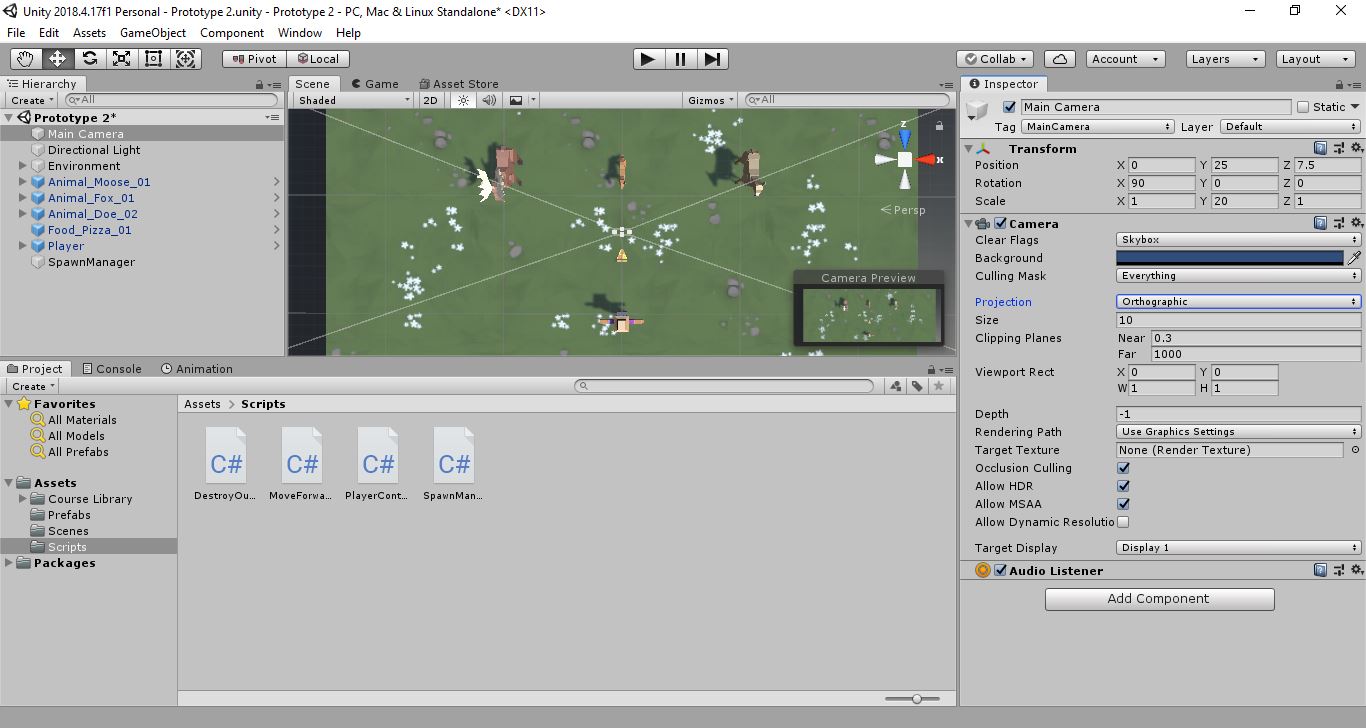
(Screenshot of my Unity HUD)
Showing posts with label Week 4. Show all posts
Sunday, 1 March 2020
Tutorial 4
I struggled a bit with this tutorial but I got through it in the end. At the beginning when I changed the names of the C Sharp scripts and drag them onto the assets it would give me an error message that it wasn't a Monobehavior script. I couldn't fix the issue so I gave up. The next day I tried again and added the titles to the scripts like in the videos but kept the Monobehavior at the end and it fixed the issue. I don't know why that happened given it didn't happen during tutorials two and three but I'm just glad I was able to get it working in the end. After that I found the rest of the tutorial simple and straight forward. I found learning how to code things like the invisible barriers to keep the player in the scene, having the player character shot out pizza with a press of the space button and having the animals spawn in random places very fun and rewarding. Coding without the auto filling like in the videos is still annoying and long but I still find the coding fun. So despite the issue at the beginning I enjoyed this one and am looking forward to the next part.
Saturday, 12 October 2019
Feedback Strategies
The first article I read was "Preschoolers and Praise: What Kinds of Messages Help Kids Grow?" by Deborah Farmer Kris. I found the article to interesting and it's points helpful. The article talks about how young children are stilling trying to figure out self concept, i.e, who they are and what they can and can't do, and how parents can give feedback to help them develop a growth mindset. The first tip was to give kids process praise inside of generic praise, i.e, instead of saying "It looks nice!" when a kid shows the painting they made to instead say "It looks nice! I like how you used light blue for the sky!". The next tip was to teach kids the power of "Yet". So when someone says "I can't do it", you respond with "You can't do it yet!". And the final point was to tell kids story of resilience to help them understand that anything is possible, you just takes time and work. Overall, I find these tips will be helpful when I give feedback to others.
https://www.kqed.org/mindshift/40369/preschoolers-and-praise-messages-that-can-help-kids-grow
The second article I read was "The Difference Between Praise and Feedback" by MindShift. I also found this article interesting and helpful. The article talks about how parents find it difficult on how to praise their children and it gives two examples of how to do it from two different researchers. The first way comes from Edward Deci and Richard Ryan and it is called process praise. This is where parents give feedback like "That was a clever way to figure it out" or "I really like how you used blue in this picture" to help give kids more confidence instead of giving generic feedback. The second way comes from Alfie Kohn and it is called praise and personhood. This where you don't praise your child for doing work because it makes them feel if they don't do these jobs well then they are not worthy of being loved. The article that says that overall, both methods boil down to praising how kids solve their problems and to ask them questions on how they did it.
https://www.kqed.org/mindshift/34778/the-difference-between-praise-and-feedback
https://www.kqed.org/mindshift/40369/preschoolers-and-praise-messages-that-can-help-kids-grow
The second article I read was "The Difference Between Praise and Feedback" by MindShift. I also found this article interesting and helpful. The article talks about how parents find it difficult on how to praise their children and it gives two examples of how to do it from two different researchers. The first way comes from Edward Deci and Richard Ryan and it is called process praise. This is where parents give feedback like "That was a clever way to figure it out" or "I really like how you used blue in this picture" to help give kids more confidence instead of giving generic feedback. The second way comes from Alfie Kohn and it is called praise and personhood. This where you don't praise your child for doing work because it makes them feel if they don't do these jobs well then they are not worthy of being loved. The article that says that overall, both methods boil down to praising how kids solve their problems and to ask them questions on how they did it.
https://www.kqed.org/mindshift/34778/the-difference-between-praise-and-feedback
(An installation of feedback. Found here.)
Game Idea Research
The game idea I am going with for my project is the collectathon idea. I am going with this idea because I feel it can be simple enough to do but allow me the space to be creative with it. The main mechanic for this game will be collecting objects around the open world, gathering a certain amount to complete the game. Another mechanic I was thinking of was combat. You will be able to attack and kill enemies in the world. And the last mechanic I was thinking of using was puzzle elements, where the player would preform puzzles like remember pasterns or moving objects in a certain to get access to items to collect.
(The titular characters of Banjo Kazooie collecting an object in the game. Found here.)
These are the videos and articles I used in my research on the subject of collectathon games.
https://www.youtube.com/watch?v=Xa31tdykDwQ
http://www.theculturecache.com/what-makes-a-good-collectathon-.html
https://medium.com/nyc-design/a-genre-never-dies-68b53e5ff0f4
https://www.youtube.com/watch?v=Xa31tdykDwQ
http://www.theculturecache.com/what-makes-a-good-collectathon-.html
https://medium.com/nyc-design/a-genre-never-dies-68b53e5ff0f4
Tuesday, 8 October 2019
Game Elements
I found the main article on the week four reading page quite insightful. It gave a good basic introduction to atomic game elements like players, objectives, rules, resources, game state, information, sequencing, player interaction and theme and how they come together to form a game system. Finding out how these different elements can work together in so many different was, with the slightest change dramatically changing how a game works was fascinating. I also found the information on critical analysis very helpful. I've never really done critical analysis, so with the questions and points listed, it should be easier from now on.
https://view.officeapps.live.com/op/view.aspx?src=https%3A%2F%2Fwww%2Edropbox%2Ecom%3A443%2Fs%2F51gox34zmmjv3t3%2FWhat%2520are%2520the%2520Qualities%2520of%2520Games%2Edocx%3Fraw%3D1&wdAccPdf=0
I could not read any other article because the link was not working.
https://view.officeapps.live.com/op/view.aspx?src=https%3A%2F%2Fwww%2Edropbox%2Ecom%3A443%2Fs%2F51gox34zmmjv3t3%2FWhat%2520are%2520the%2520Qualities%2520of%2520Games%2Edocx%3Fraw%3D1&wdAccPdf=0
(A game system. Found here.)
I could not read any other article because the link was not working.
Subscribe to:
Posts (Atom)


